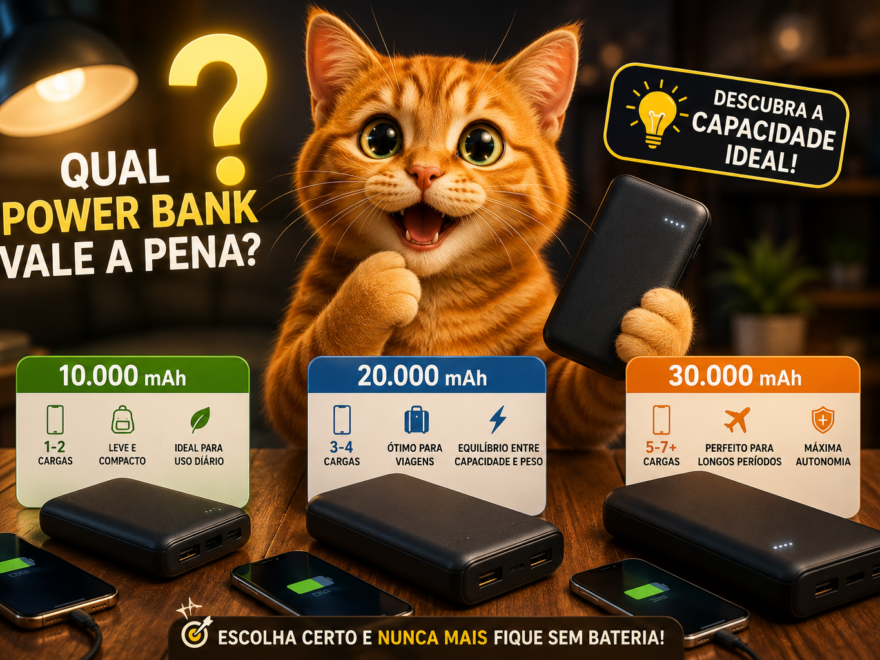
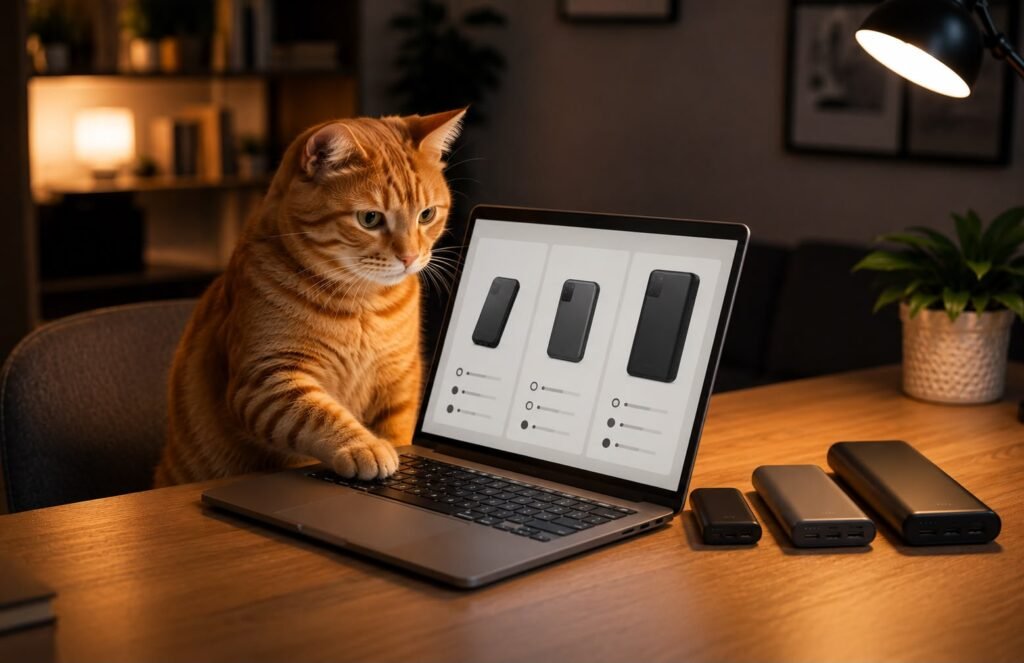
Picking the best power bank seems easy until you open any online store and face dozens of options, capacities, and wildly different prices. The instinct is understandable: just grab the one with the biggest mAh number and call it done.
The problem is that chasing raw capacity can lead you to overspend — or worse, to buy a model that doesn’t fit how you actually use your phone. This guide breaks down what capacity really means, how it relates to your device’s battery, and what other specs matter just as much as the mAh number when choosing the best power bank for your needs.
What Does mAh Actually Mean?
mAh — The Unit Explained Simply
mAh stands for milliampere-hour — the unit that measures how much energy a power bank can store. The higher the number, the more energy it holds. In theory.
But more mAh doesn’t automatically mean better. Higher-capacity models tend to be heavier, more expensive, and — depending on how you use your devices — may hold far more energy than you’ll ever realistically drain.
Nominal Capacity vs. Real-World Capacity
The number printed on the packaging is the nominal capacity. It’s not what actually reaches your phone. During the energy conversion from the internal battery cell to the USB output, a portion is lost as heat.
Internal circuitry efficiency also varies significantly from brand to brand. In practice, a 10,000mAh power bank typically delivers between 60% and 70% of its rated capacity as usable charge — somewhere between 6,000 and 7,000mAh of real output.
How Many Charges Does a Power Bank Actually Provide?
Once you know that, it’s easier to calculate real-world charges. A phone with a 4,000mAh battery, for example, gets roughly 1.5 to 1.7 full charges from a 10,000mAh power bank.
Here’s a practical reference table:
| Phone Battery | 10,000mAh Bank | 20,000mAh Bank | 30,000mAh Bank |
|---|---|---|---|
| 4,000mAh | 1.5–1.7 charges | 3–3.5 charges | 5–5.5 charges |
| 5,000mAh | 1.2–1.4 charges | 2.5–3 charges | 4–4.5 charges |
| 6,000mAh | 1–1.2 charges | 2–2.5 charges | 3.5–4 charges |
10,000mAh Power Banks — The Best Balance of Size and Portability
Who Actually Needs One?
A 10,000mAh power bank is the sweet spot for anyone who just wants a daily top-up. It fits in a purse, a backpack, or even the large pocket of a jacket.
It works well for commutes, gym sessions, or weekend outings — as long as you have access to an outlet at some point during the day to recharge it.
Pros and Cons
The main advantage is weight: the Anker Nano 10K, for example, comes in at just 181g — and most models in this category fall between 170g and 230g, noticeably lighter than larger-capacity options. They’re also usually cheaper and faster to fully recharge. Amazon
The downside is limited capacity. If you’re spending a full day away from any outlet, a 10,000mAh power bank might not be enough to keep up.
20,000 and 30,000mAh Power Banks — When Is the Extra Capacity Worth It?
Who Actually Needs High Capacity?
Long trips, remote work without reliable power access, camping, and multi-day travel are the scenarios where a 20,000 or 30,000mAh power bank earns its place. It’s also worth considering if you regularly charge someone else’s device alongside your own.
If you use a laptop with USB-C charging support, a high-capacity model with enough wattage can serve as an emergency power boost — depending on the output specs.
Is It Worth the Premium Price?
The trade-off isn’t just about cost. A 30,000mAh power bank typically weighs between 550g and 650g — nearly double a 10,000mAh model — and that weight adds up in a backpack.
For frequent travelers or anyone spending extended time away from outlets, the extra capacity justifies the investment. But for lighter everyday use, 30,000mAh may be more than you’ll ever need.
Best Power Bank for iPhone
What to Check Before You Buy
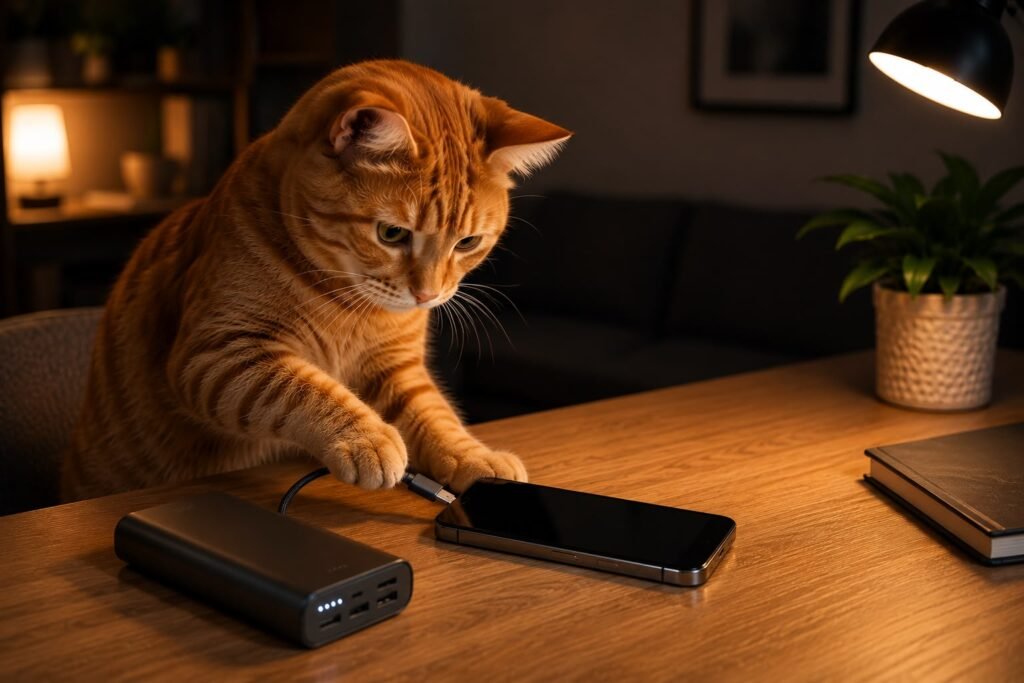
Recent iPhones use USB-C. Older models still use Lightning — so confirming the connector type before buying is essential.
Also check for Power Delivery (PD) support — the fast-charging standard that works over USB-C. To take advantage of fast charging speeds, look for a power bank rated at 20W or higher.
If you use a MagSafe case or stand, a MagSafe-compatible power bank is worth considering for the convenience of cable-free snap-on charging — though wired output is always faster.
See also: 7 Best AI Smartphones to Buy in 2026
Best Capacity for iPhone Users
For daily use, 10,000mAh covers most people comfortably. Travelers and heavy users tend to prefer 20,000mAh — the right balance between capacity and weight.
30,000mAh only makes sense if you’re also charging an iPad, a laptop, or multiple devices from the same power bank.
Best Power Bank for Samsung Galaxy
Fast Charging on Galaxy Devices
The Galaxy lineup supports USB Power Delivery, but many recent models use PPS — Programmable Power Supply — a protocol that dynamically adjusts voltage for more efficient, safer charging.
Devices with Samsung’s Super Fast Charging need a power bank that supports PPS to deliver the advertised speed. Without it, charging falls back to standard speeds.
Which Capacity for Galaxy Users?
For the Galaxy A series, a 10,000 to 20,000mAh power bank handles daily use well. The Galaxy S series — with larger screens and higher power draw — benefits from 20,000mAh.
Galaxy Z Fold and Flip users, whose foldable screens consume more battery, tend to favor 20,000mAh or more. For Samsung tablets, 20,000mAh is the minimum worth considering.
What to Evaluate Before You Buy a Power Bank
Output Wattage
Wattage determines charging speed. 18W and 20W models cover most smartphones well. 30W, 45W, and 65W outputs charge significantly faster. 100W models can charge most laptops — including MacBook Air and many Windows ultrabooks — though high-performance models like the MacBook Pro 16″ may require more than 100W for full-speed charging. These high-output power bank options come at a higher cost and weight, worth it only if you genuinely need that level of output.
Number of Ports
Multiple USB-A and USB-C ports let you charge two or more devices at once. Keep in mind: when multiple outputs are active simultaneously, the available wattage is typically split between them, which slows down individual charging speeds.
Battery Quality and Safety
Look for power bank models with built-in protection against short circuits, overcharging, and overheating. Certifications like CE, FCC, and regional safety standards are signals that the product has passed standardized safety testing.
Battery longevity also matters: well-built cells maintain most of their capacity after hundreds of charge cycles. Cheaper cells degrade noticeably faster.
Size and Weight
Bigger capacity means bigger and heavier — it’s a straightforward trade-off between portability and endurance. Decide which side of that equation matters more for how you actually use your devices.
Most Reliable Brands
When buying a power bank, brands like Anker, UGREEN, Baseus, Xiaomi, and Samsung have established strong reputations for quality and post-purchase support. Always check recent reviews before committing to a model.
Capacity Comparison Table
| Capacity | Best For | Portability | Approx. Charges* |
|---|---|---|---|
| 10,000mAh | Daily use | ⭐⭐⭐⭐⭐ | 1.2–1.5 charges |
| 20,000mAh | Travel and work | ⭐⭐⭐ | 2.5–3 charges |
| 30,000mAh | Heavy/multi-device use | ⭐⭐ | 3.5–4.5 charges |
*Approximate values for phones with 4,500–5,000mAh batteries, based on 60–70% real-world efficiency.
Top Power Bank Picks by Capacity
Specifications verified before inclusion:
| Category | Top Pick | Max Output | Ports | Why It Stands Out |
|---|---|---|---|---|
| 10,000mAh | Anker Nano Power Bank (10K, 45W) | 45W single port* | 1 USB-C + 1 USB-A | Built-in retractable USB-C cable so you never forget a cable, 45W fast charging on a single port, compact 181g build, Anker’s proven reliability |
| 20,000mAh | UGREEN Nexode 20,000mAh 100W | 100W single port | 2x USB-C + 1x USB-A | 100W single-port output charges a MacBook to 50% in about 30 minutes, recharges fully in 1.6 hours, under 500g |
| 30,000mAh | Baseus Bipow 30,000mAh 20W | 20W (USB-C single port) | 2x USB-A + 1x USB-C + Micro-USB | Confirmed 30,000mAh capacity with digital display, multi-device support, strong value for high-capacity needs |
*Output splits when multiple ports are used simultaneously — USB-C drops to 15W and USB-A to 7.5W when both are active at the same time.
Conclusion: The Best Power Bank Is the One That Fits Your Life
There’s no single best power bank in the absolute sense — there’s the right one for how you actually use your devices. If you want everyday portability, 10,000mAh wins. If you travel frequently or work away from outlets, 20,000mAh is the practical sweet spot. If you need maximum endurance across multiple devices, 30,000mAh is worth the extra weight.
Before you buy any power bank, look beyond the mAh number: output wattage, fast-charging protocol compatibility with your specific device, and brand reliability matter just as much as raw capacity.
Now that you know how to find the best power bank for your needs, explore our full reviews of the top 10,000, 20,000, and 30,000mAh picks and find the right model for your daily routine. Still have questions? Drop a comment with your phone model and we’ll point you to the right fit.